Florence: I Didn’t Expect This Much

I’ll be honest, I went to Florence without particularly high expectations. I knew about the David, vaguely knew about the Uffizi, and assumed it would be a nice Italian city with some art in it. What I found was a city so dense with things worth seeing that three days felt tight and a week wouldn’t feel excessive. If there’s one city in Italy that genuinely rewards time and a bit of planning, it’s this one.
Getting There
By train: The Frecciarossa high-speed service from Rome takes around 1.5 hours, with advance tickets from as little as €20 if you book early or around €45 the day before. From Milan it’s under two hours. Book through Trenitalia or Italo as far in advance as possible, since prices climb significantly closer to the date. Florence’s main station, Santa Maria Novella, sits right in the centre of the city.
By Flixbus: Cheaper and considerably slower. Rome to Florence on Flixbus takes around three hours and starts from about €9 booked in advance. From Milan it’s around 3.5 hours from €7. The trade-off is time, and Florence rewards extra days there more than it rewards saving €10 on the journey. Take the train if you can and bear in mind traffic in Italy can be unexpectedly bad and add hours to your bus trip.
Where to Stay
Stay south of the river, around the Oltrarno neighbourhood. It’s quieter, noticeably cheaper than the hotel-dense centre north of the Arno, and still a comfortable walk to every main attraction. I’d have stayed somewhere more central if I’d booked without thinking about it, and I’m glad I didn’t. The Oltrarno has a completely different feel to the tourist-heavy areas around the Duomo, more like an actual neighbourhood and less like a museum gift shop.
Before You Arrive: Download the Rick Steves Audio Europe App
The free Rick Steves audio guides for Florence cover more than almost anywhere else in the collection. Download them before you land and you have free, high-quality walking tours in your pocket for all of the following:
- Renaissance Walk
- Uffizi Gallery
- Accademia Gallery (David)
- Bargello Museum
These are as good as a paid guide. Better, in most cases, because you can pause, rewind, and go at your own pace without waiting for a group. Take a pair of earphones and use them everywhere.
Book These Two in Advance: Non-Negotiable
The Uffizi and the Accademia both sell out in peak season, and the queues for same-day tickets run for hours. Book both before you travel.
The official booking site for the Uffizi is tickets.uffizi.it. Adult tickets cost €25 walk in and €29 in advance. You don’t want to be caught in the line waiting hours for a walk in ticket. The Accademia books through the B-ticket system at webshop.b-ticket.com, with adult tickets at €24 including the booking fee. Aim to book the Accademia at least two months ahead in high season, the Uffizi at least a month ahead.
The Uffizi Gallery
I’m not really a museum person. Some of them feel like obligation: large rooms, well-labelled paintings I half-recognise, feet hurting, moving on. The Uffizi didn’t feel like that. It has a set route that works like a story, walking you through the arc of the Italian Renaissance chronologically, and that structure makes a real difference. You feel the progression rather than just looking at individual objects in rooms.

The Botticelli rooms are the headline: The Birth of Venus and Primavera in the same space, both larger than you expect, both stopping you mid-step. But the da Vinci rooms, the Caravaggio section, and the Michelangelo and Raphael hall all earn their time too. Put the Rick Steves audio guide on and plan for two to three hours at minimum. This is one of those places where rushing it is actively the wrong choice.
Budget at least half a day here. It’s dense and it rewards patience. It’s famous for good reason
Uffizi: Rated.
The Accademia and the David
I went in very sceptical. There’s a full-scale replica of the David in Piazza della Signoria, out in the open, free, available any time. I wasn’t sure the original would feel meaningfully any different.

I was wrong. Walking up the corridor of Michelangelo’s unfinished Prisoners, those extraordinary half-emerged figures straining out of their marble blocks, builds you up for the moment the David comes into view at the end of the hall. And the real thing, under the natural light of the domed skylight, at five and a half metres tall, is something the replica doesn’t prepare you for. The scale hits differently. The detail in the hands and the veins and the expression lands differently. It was a more affecting experience than I expected. Though not super big, there’s also more than just the David here too, including a packed sculpture room.
The Rick Steves audio guide for the Accademia is worth using here too. Closed Mondays.
The David: Rated.
The Duomo Complex
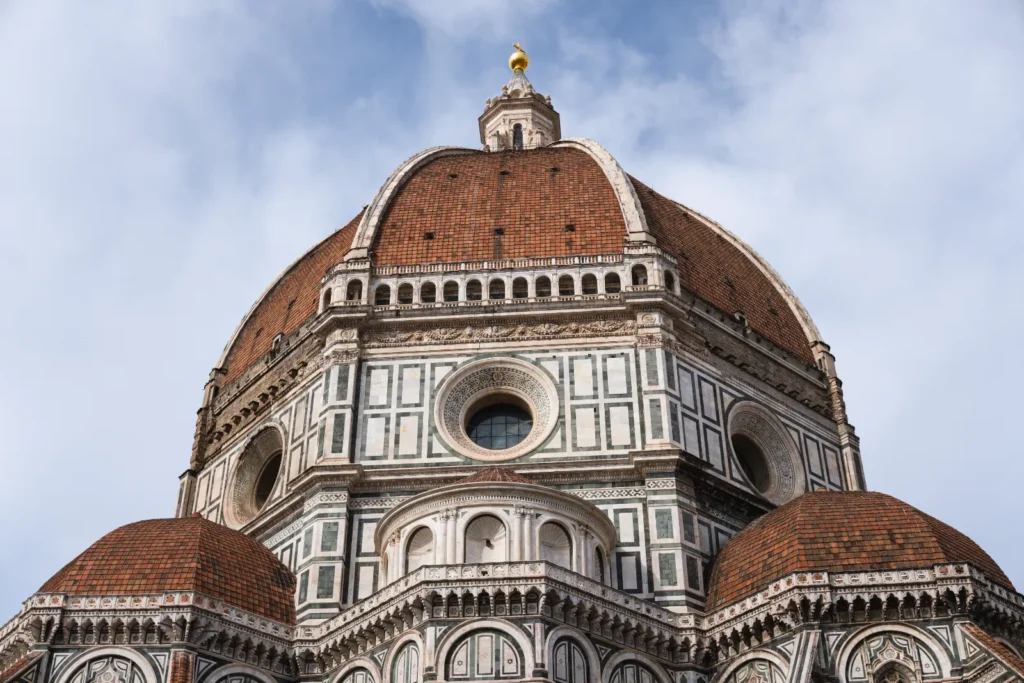
The exterior of the Cattedrale di Santa Maria del Fiore is one of those things you turn a corner and suddenly understand why people come to Florence. The pink, white, and green marble facade covers a scale that’s impossible to get into a single photograph, and the terracotta dome rising behind it, Brunelleschi’s dome, is even more extraordinary when you know the story of how it was built without scaffolding using interlocking brickwork that had never been attempted before. Choose what interests you and what you’re willing to pay for. Check up to date prices here.
Brunelleschi’s Dome: The 463-step climb to the top gives you panoramic views of the whole city and a close-up look at the frescoes on the inside of the dome that you can’t properly see from below. This one sells out well in advance, mandatory booking ahead.
Giotto’s Bell Tower: The alternative if the dome is sold out, or simply if you want a view that includes the dome in the frame rather than from within it. 414 steps, slightly easier climb, excellent view.
The Baptistery: The octagonal building opposite the cathedral entrance, with its original bronze doors by Ghiberti and a stunning gold mosaic ceiling inside. Often overlooked in favour of the bigger sights, which is a mistake.
Opera del Duomo Museum: Probably the most underrated thing in the whole Duomo complex. Houses the original Gates of Paradise bronze doors (replicas stand outside; the real ones are in here), along with original sculptures from the cathedral and Ghiberti’s self-portrait embedded in the doors. The building itself is designed specifically to display these pieces. Worth two hours and rarely as busy as the Duomo or dome.
Piazzale Michelangelo: Go Every Evening
I went here for sunset every night I was in Florence and I’d do the same again. It’s a fifteen to twenty minute walk uphill from the river, through the gardens on the south bank, and the view from the terrace is everything: the Duomo, the whole city skyline, the hills behind, the Arno below. Everybody goes, which means it’s busy, but it doesn’t feel tourist-trap busy in the way some things in Florence do. It feels like the city’s own ritual.

There was usually a musician at the bottom of the steps. The light on the city in the last twenty minutes before the sun drops is the kind of thing you try to photograph and eventually give up on, since the photo never captures it properly.
Go up through the Giardino delle Rose on the way, a free terraced rose garden with its own views over the city. Better than the Boboli Gardens in my view and free.
Ponte Vecchio
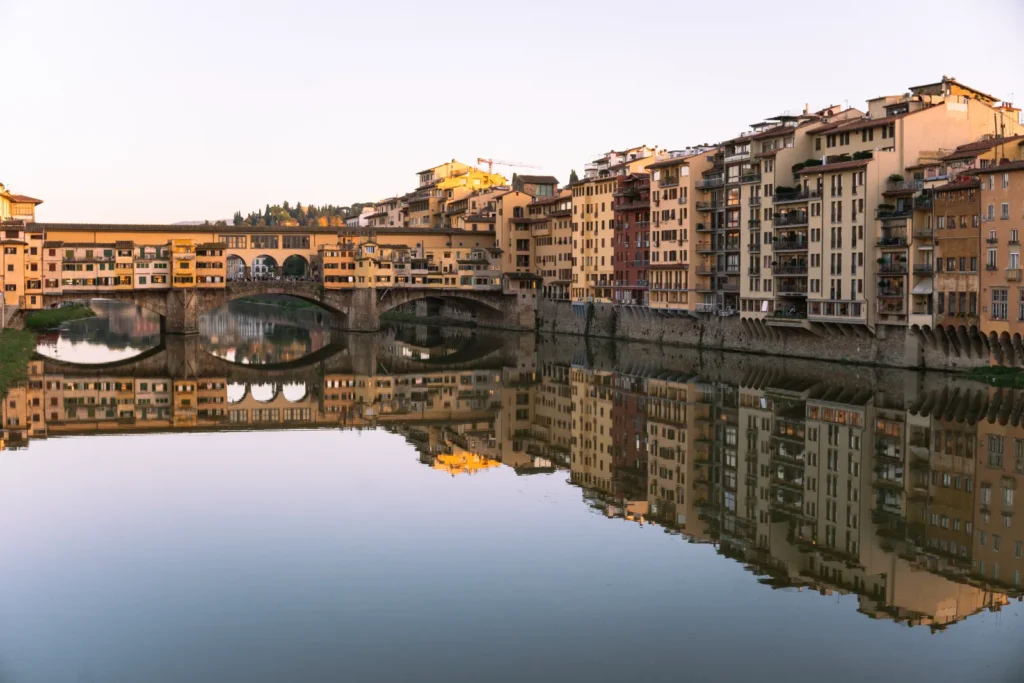
The Old Bridge is one of those things that earns its reputation. A medieval bridge covered on both sides with goldsmiths’ and jewellers’ shops, almost unchanged since the 16th century. Walk across it in either direction. For the best photograph of the bridge itself, walk to Ponte Santa Trinita and shoot back toward it as the sun drops, when the city lights start to come on and reflect in the water.
Piazza della Signoria
The main political square of Florence and still the busiest, most atmospheric spot in the city. The Loggia dei Lanzi on one side houses genuine Renaissance sculptures in an open-air gallery with no entrance fee and no queue: Perseus holding Medusa’s head, the Rape of the Sabine Women, Hercules and Cacus. All outdoors, all free, all extraordinary.
The replica David stands outside the Palazzo Vecchio here too, in case you want to see what you’re comparing to before you go to the real one.
The Palazzo Vecchio itself is worth going inside if you have time: the Salone dei Cinquecento is a vast hall covered in massive frescoes that gives you a sense of what civic power looked like in Renaissance Florence. The tower is climbable for an unobstructed view directly at the Duomo.
Still Want More To Do?
The Oltrarno
The south bank of the Arno has a completely different energy to the main tourist areas. Independent artisan workshops, leather shops, quieter streets, and Piazza Santo Spirito, which is a much better spot for a morning espresso or evening glass of wine than anything in the main drag.
Pitti Palace and Boboli Gardens: I’ll be straight about these. The Pitti Palace was a disappointment after everything else in Florence. It has art, there’s plenty of it, but nothing that hit the way the Uffizi did, and after a few days in a city this dense with significant things it felt like more of the same rather than something additional. The Boboli Gardens behind it is a large, pleasant park with fountains and statues, but essentially it’s a park. If I were doing Florence again I’d skip the Pitti and walk up to Piazzale Michelangelo through the rose gardens for free instead.
Basilica di Santa Croce: The facade is impressive and the interior houses the tombs of Michelangelo, Galileo, Machiavelli, and Rossini, among others. Worth a look. Often quieter than the Duomo area.
Bargello Museum: A medieval palace housing one of the best sculpture collections in the world, including Donatello’s David, arguably the more interesting David in artistic terms. If you have an extra day or want something off the main path, this is worth a couple of hours.

Basilica di Santa Maria Novella: The facade near the train station is impressive and the church itself costs €7.50 to enter. Often missed entirely because people assume it’s just the big church near the station. It isn’t. The interior frescoes and the structure are proper Renaissance work.
Leonardo da Vinci Exhibition
I had some spare time and ducked into one of the Leonardo exhibitions that runs in Florence. It was cool in the way that seeing a living model of a machine designed five centuries before it was built is always going to be cool. The inventions are extraordinary, the mind behind them even more so, and the interactive nature of the exhibits means you can actually operate the mechanisms and see how they work.
Fair warning though: it’s aimed primarily at children and it shows. Running kids are very much part of the experience. If you have them with you, they’ll love it. As a solo adult experience, manage your expectations and enjoy it for what it is rather than what you might be hoping for.
Food
Florence takes gelato seriously. Skip anything with piled-high neon mounds and look for artisanal gelaterie storing it in metal tubs with lids. Pistachio should be pale green and slightly sandy-coloured, not bright green. The colour tells you whether there’s real pistachio in it.
The Mercato Centrale near San Lorenzo is worth a visit: ground floor for produce, cheese, truffle oil, and meat from local vendors, upper floor for a food hall where you can sit and eat fresh pasta, pizza, lampredotto (Florentine tripe sandwich, worth trying once), and local wine. Better than most tourist-area restaurants and more honest about what it is.
A Sandwich Worth Queuing For (Mostly)
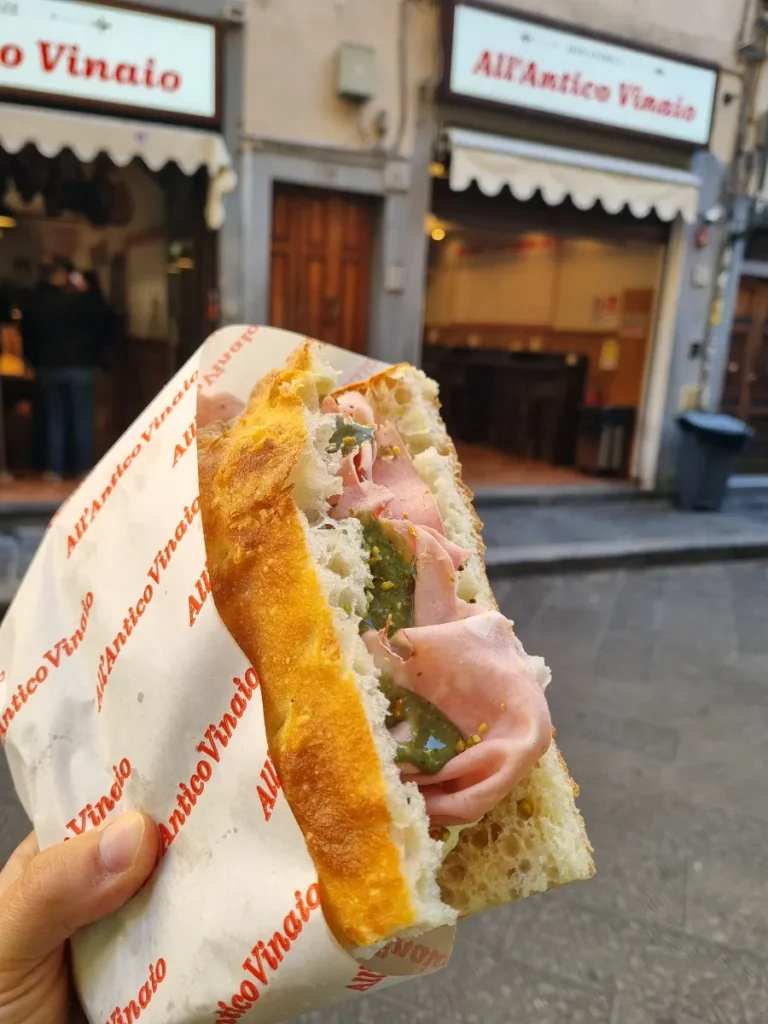
All’Antico Vinaio on Via dei Neri is the famous sandwich shop, one of the most talked-about food stops in Florence. There’s actually now several identical shops on the same street to keep up with the demand. Queue up at any. People queue before it opens and the line moves constantly. It’s worth trying, the schiacciata bread stuffed with cured meats, cheese, and truffled spreads is good and filling. I wouldn’t say it’s super cheap for a sandwhich but everyone who’s been to Florence will tell you to go so you might as well. Give it a go and make your own decision on whether it lives up to the hype.
Practical Notes
Florence is entirely walkable. I didn’t use any transport beyond my own feet for three full days. The city is compact and the distances between things are shorter than they look on the map.
Book the dome, the Uffizi, and the Accademia before you leave home. Everything else can be figured out on arrival.
The first Sunday of each month, state museums including the Uffizi and Accademia are free. No advance booking is available on these days, so expect longer queues, but if the dates align it’s worth planning around.
Verdict: RATED
I went in without high expectations and came away thinking it might be the best city in Italy. More to do than almost anywhere else in the country, all of it within walking distance, and the Uffizi alone justifies the trip.